Iran’s National Uprising with JavidShah
in
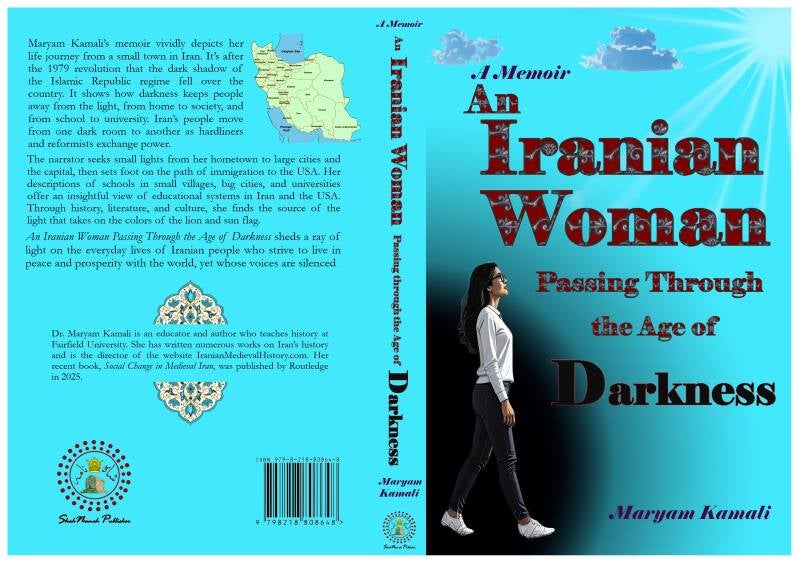
An Iranian Woman Passing Through the Age of Darkness
Even though we live in the 21st century, the political leadership in Iran has been conducted by a medieval theocratic system since February 1979. In her memoir, Maryam Kamali vividly depicts her life journey from a small town in Iran, after the 1979 revolution cast the dark shadow of the Islamic Republic regime over the country. It illuminates how darkness keeps people away from the light, from home to society, and from school to university. Iran's people move from one dark room to another as hardliners and reformists exchange power. Throughout the book, you will find sections that depict the dividing lines between people seeking light and the regime doing its best to keep them in darkness.
The narrator pursues small lights from her hometown to big cities and the capital, then sets foot on the path to immigration to the USA. Her description of schools in small villages, large cities, and universities offers a comparative view of the educational systems in Iran and the USA. Through history, literature, and culture, she uncovers the source of the light that takes on the colors of the lion-and-sun flag. An Iranian Woman Passing Through the Age of Darkness sheds a ray of light on the everyday lives of Iranian people who seek to live in peace and prosperity with the world, yet whose voices are silenced.
Maryam Kamali wrote this book to let the world know about Iran under the Islamic Republic, which took the country back to the dark chapters of the Middle Ages. The book includes a prologue, ten chapters, and an epilogue covering the period from just after the regime's rise in 1979 to the present. One of the main themes the author explores is the uprisings against the regime and how people, step by step, came to understand what kind of government they wanted to have after the barandazi (overthrow) of the regime. In one of the sections of chapter ten, Maryam Kamali talks about the slogans of one of the most recent uprisings in Iran, which was in 2022:
Slogans of Iran’s National Uprising: JavidShah
The Mahsa movement was a crucial part of a nationwide uprising connected to protests in 1999 and 2009. Although the demonstrations initially focused on government issues like elections, they later became a platform for broader public demands. This change is apparent in slogans such as “the elections are an excuse, the whole system needs to be overthrown” and “My life is for Iran,” which became popular during protests in 2017 and 2019.
The uprisings didn’t aim to reform the Islamic Republic; they viewed it as illegitimate, founded on terror, repression, and deception. Young people, both girls and boys, shouting slogans in the streets and universities, sought to overthrow the regime. They wanted to establish a secular government based on the will of the Iranian people.
Many protesters, especially young people and teenagers, were killed and arrested by the Islamic Republic. It shot at protesters, whose only weapons were their slogans. Bullets blinded and killed young people. On the one hand, the suppression of protests and the silence of international circles in the face of these repressions forced the youth to take their protests to stadiums. This was the only place where they could gather safely, reducing the risk of being recognized and suppressed. The stadiums were filled with voices shouting, “Reza Shah, may your soul rest in peace,” and “When Shah is not in Iran, it’s in chaos,” which were heard multiple times during the game.
One of the slogans shouted during this season of national uprising was “woman, life, freedom.” This slogan was shouted on Mahsa’s burial day and was loudly heard throughout Iran. Soon, with the addition of the words man, mihan (homeland), and Abadi (prosperity), it became an all-encompassing slogan that included all members of society regardless of gender. However, the second part of the slogan faced fundamental challenges from the beginning by some groups who aimed to sexualize the people’s uprising. Especially those who tried to limit the Iranian people’s national desire to overthrow the regime to oppose the mandatory hijab. This was while the Iranian people, both with and without a hijab, joined hands to overthrow the Islamic Republic. In every city where protests took place, people chanted that they sought to preserve their country’s integrity.
“From Tehran to Baluchestan, my life is for Iran.”
“From Kordestan to Tehran, Iran is bloodied.”
“Baluchestan and Kordestan are Iran’s eyes and lights.”
The slogans had drastically shifted from reformist to more subversive messages. They grew more patriotic each day. This patriotism had a specific color and flavor, evoking Iran’s glorious era under the Pahlavi dynasty. People took every chance in sports stadiums, subways, and buses to chant, “Reza Shah, may your soul rest in peace.” This slogan reflected their focus and desire for the return of the Pahlavi rule.
Mahmonir Molaverdi, the mother of Kian Pirfalak, whose nine-year-old son was shot by Islamic Republic mercenaries, read a poem at his funeral. The last line was: “We are a strong nation; we will reclaim Iran.” This line quickly became one of the main mottos of the Iranian nation’s revival. “We will fight, we will reclaim Iran,” was shouted in the streets of Iran. Reclaiming Iran signified that the Iranian people understood the regime occupied their country.
There was a growing sense of patriotism in the virtual space, including on the X platform (formerly Twitter), among constitutionalist monarchs. This group of cyberspace activists, some of whom also participated in protests inside Iran and occasionally provided detailed reports on the situation, began creating slogans that clarified the purpose of the protests. Chanting “Shame on the 1979 fetneh (sedition)” showed that the youth understand the cause and foundation of today’s dark situation that led to the establishment of the Islamic Republic.
In Norooz 2584 Shahanshahi (March 21, 2025), the people of Iran gathered at the Ferdowsi mausoleum and shouted: JavidShah (Long Live the Shah and Make the monarchy immortal). This reflects the Iranians’ desire for a lasting monarchical political system in their history. Iranians, as a nation, believe that the bond between Iran’s people and their Shahs, including the Pahlavi dynasty, is unbreakable. They explicitly mentioned their alternative to the Islamic Republic: Crown Prince Reza Pahlavi, the son of Mohammad Reza Shah Pahlavi, took the oath to become the Shah of Iran after his father died in 1981. “King Reza Pahlavi,” “Reza Shah Pahlavi,” “The Shah of Iran, come back to Iran,” were slogans seen on Iran’s walls and shouted in virtual spaces more than before."
Currently, there is a widespread uprising nationwide in Iran that began in the last days of December 2025 and continues to the present. In this wave of protests, people, more than before, chant: JavidShah, since they want to bring the Constitutional Monarchy back to Iran.
#JavidShah
Maryam Kamali (2025). An Iranian Woman Passing Through the Age of Darkness, Connecticut: Shahnameh, Ch. 10, pp. 553-556.